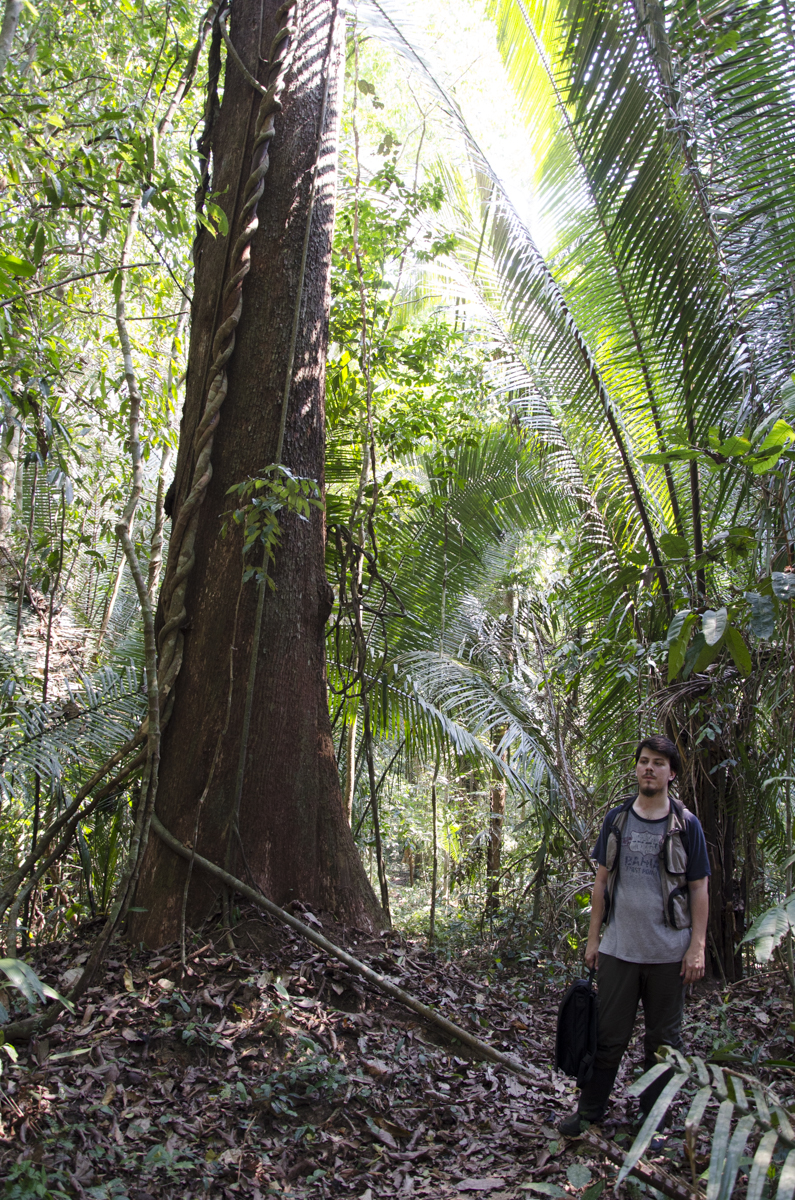
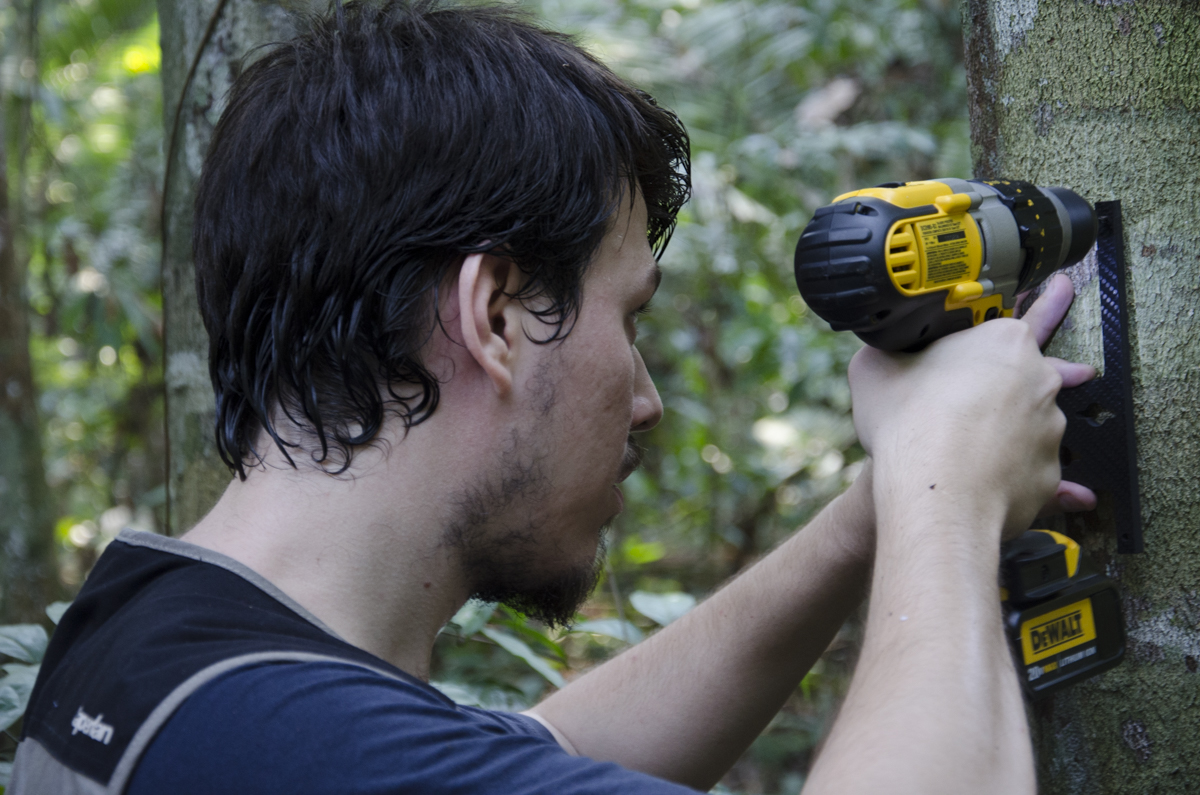
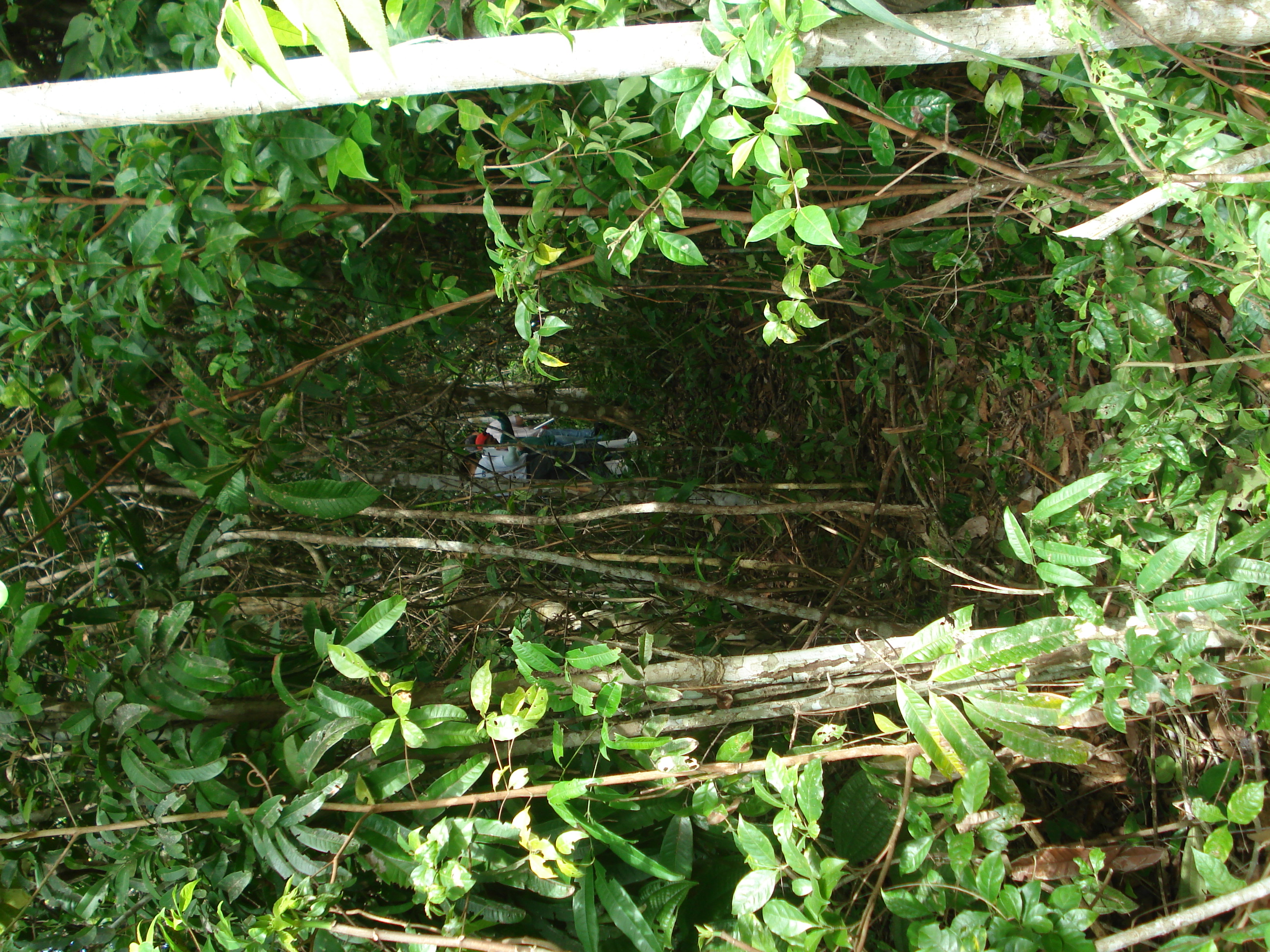
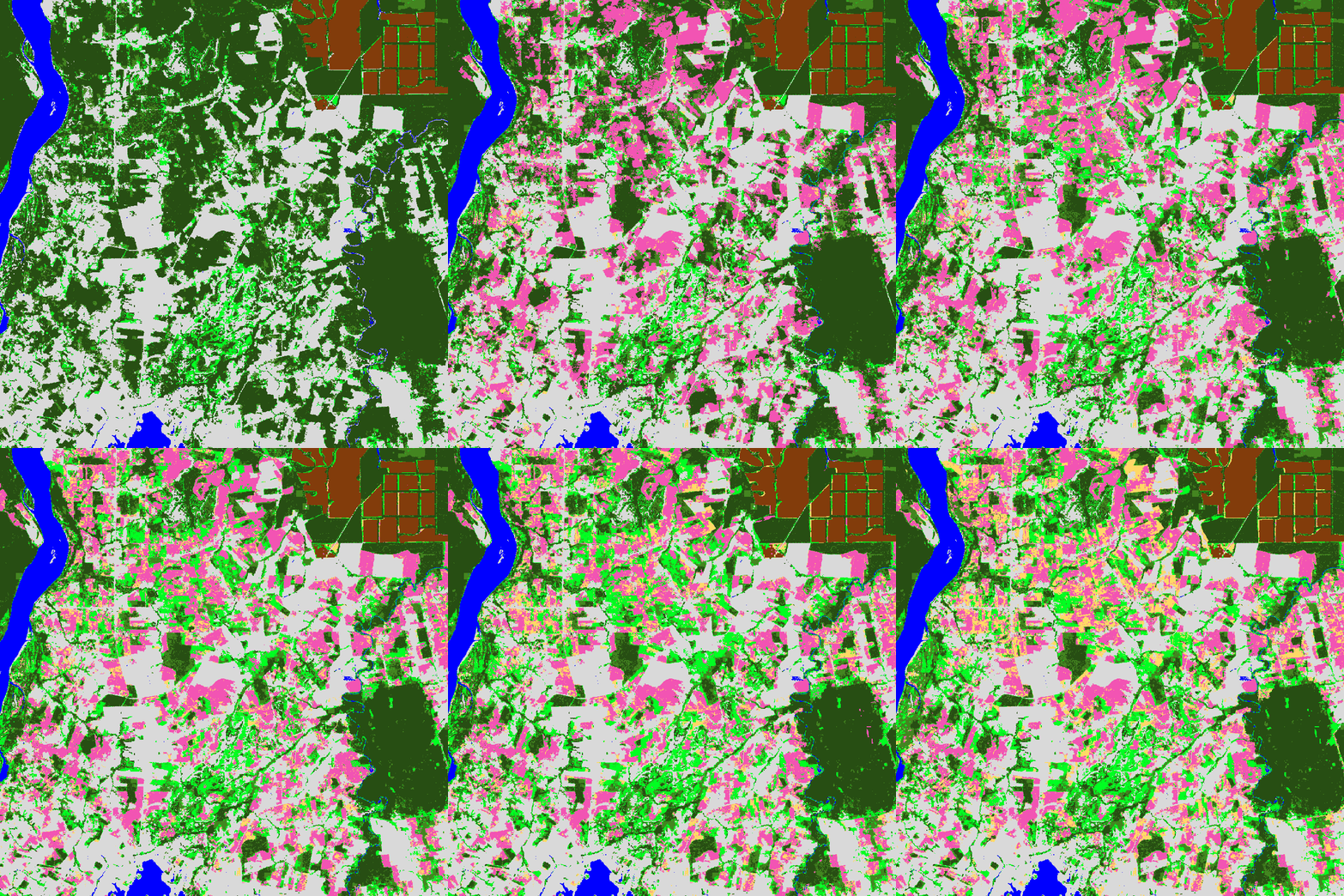
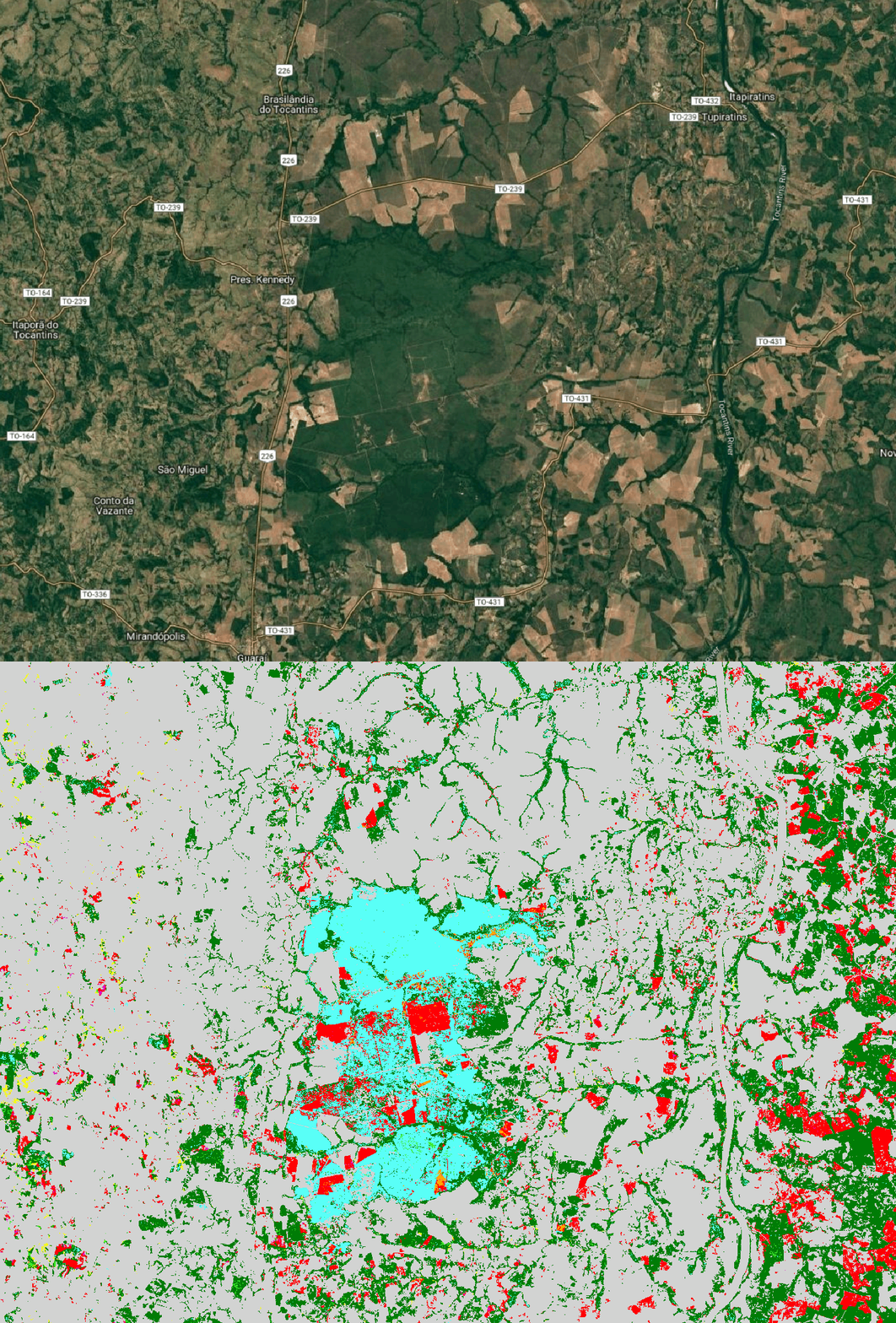
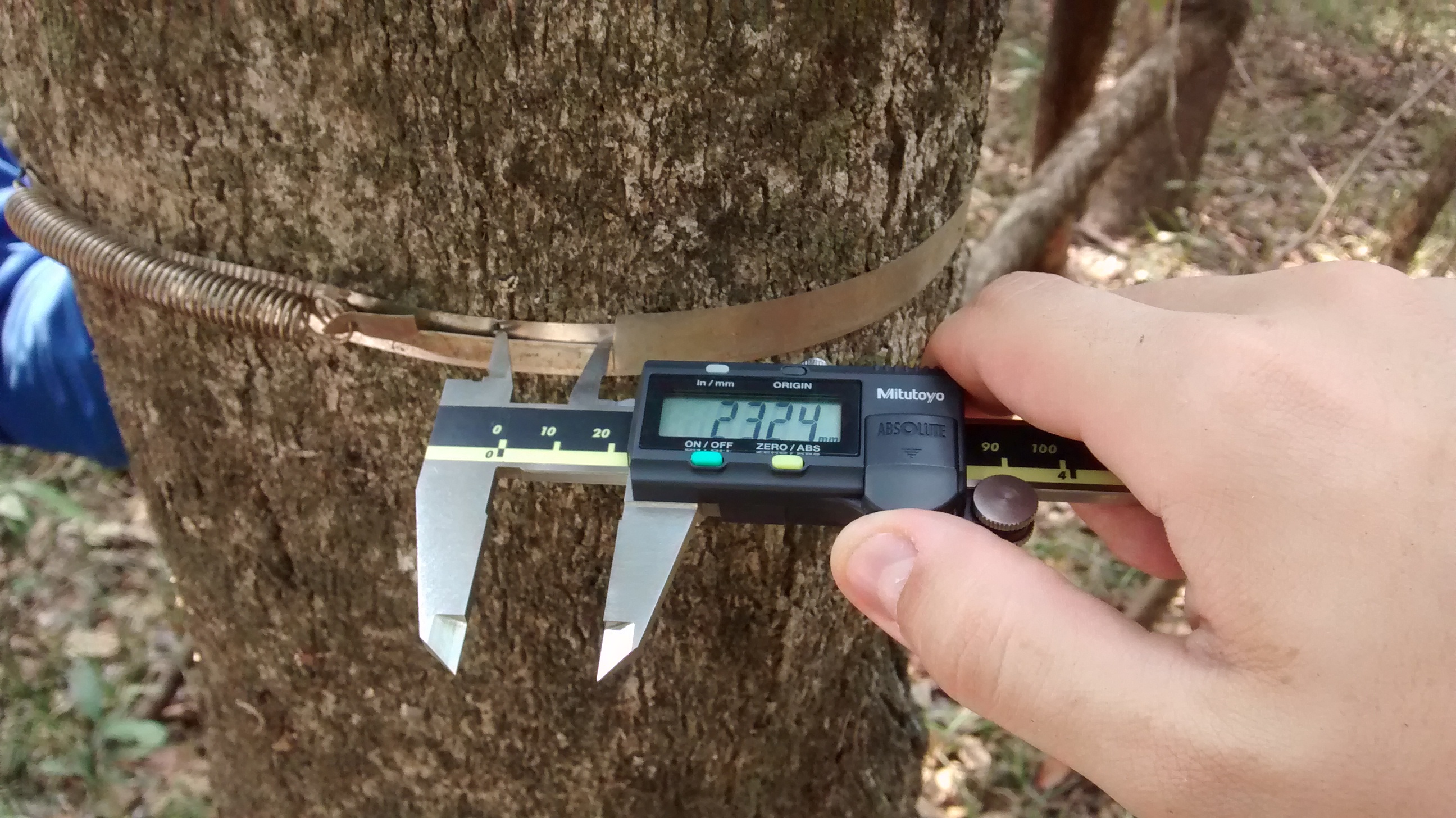
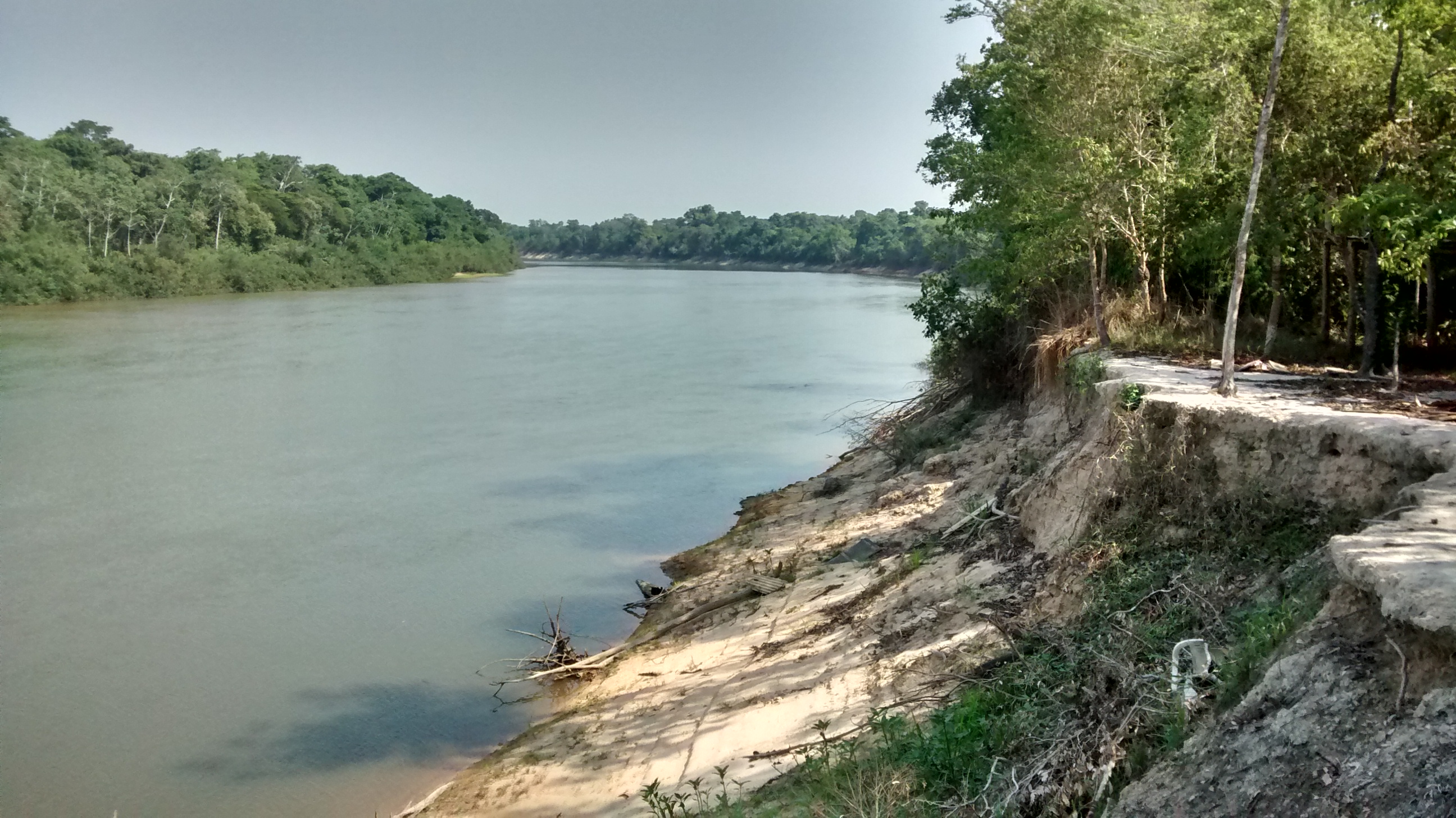
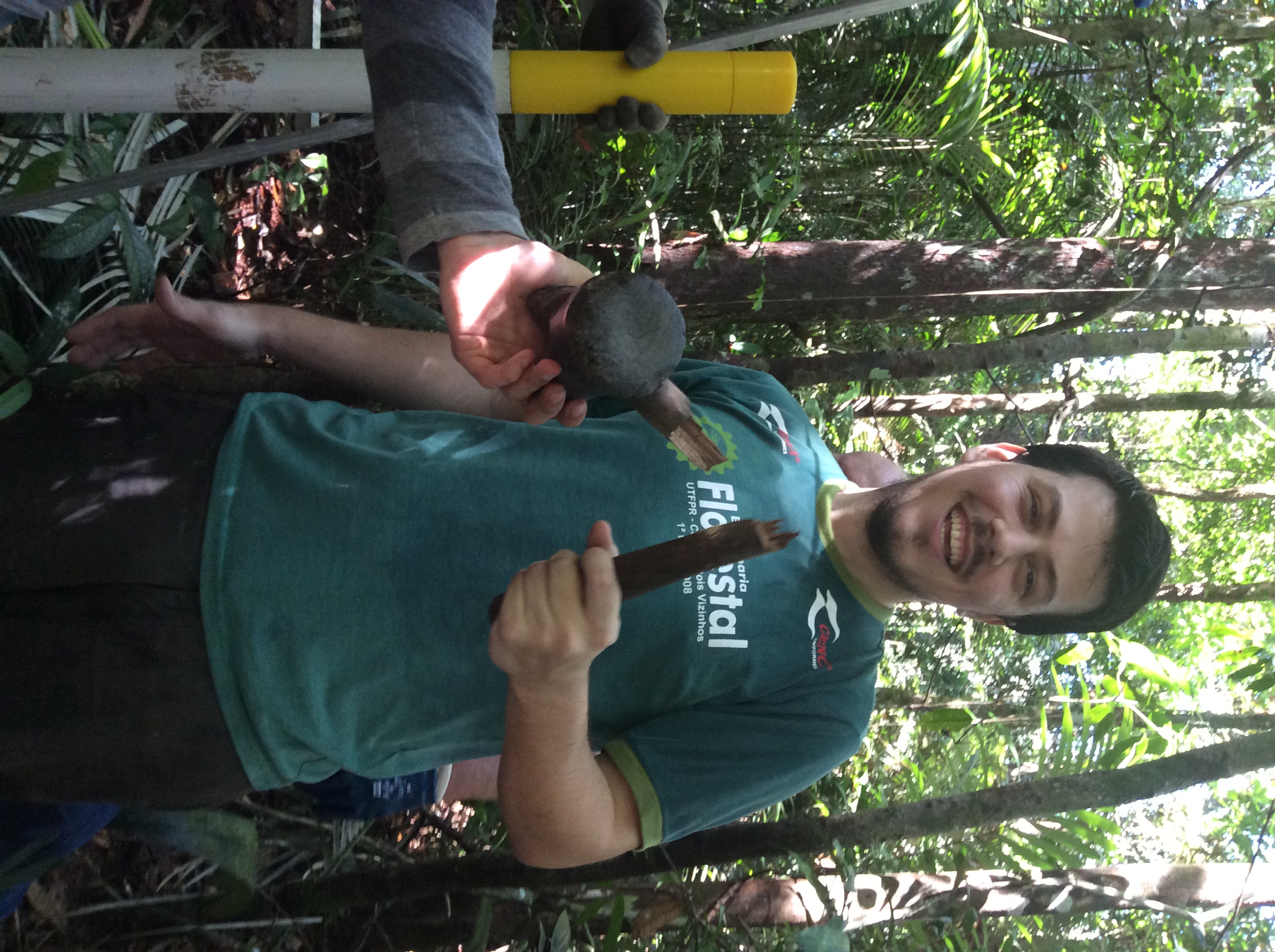
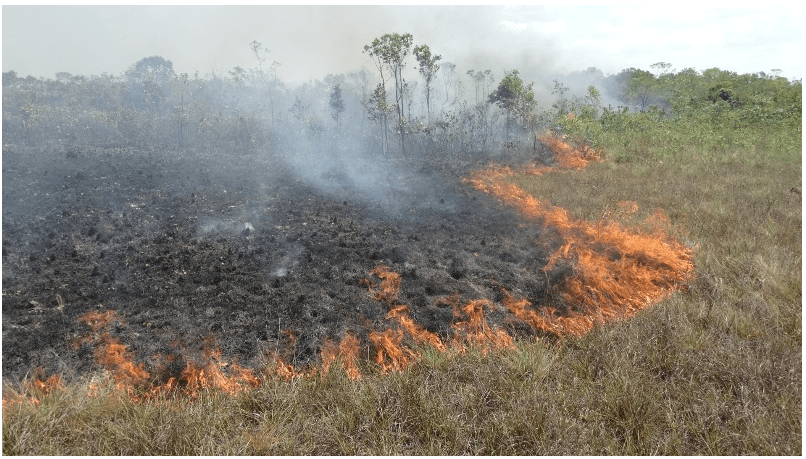
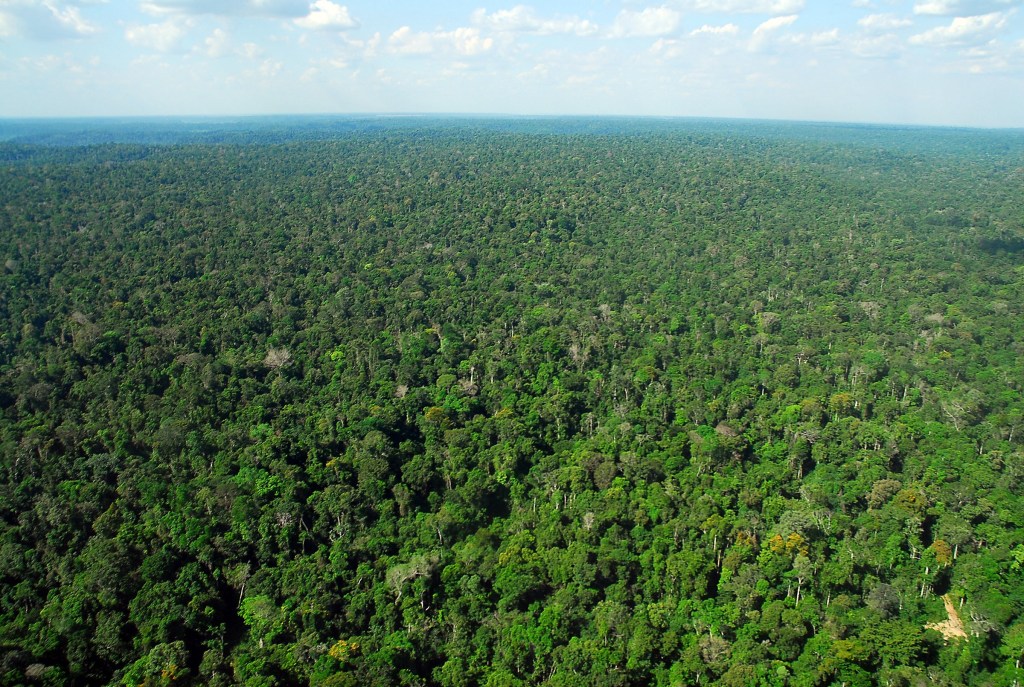
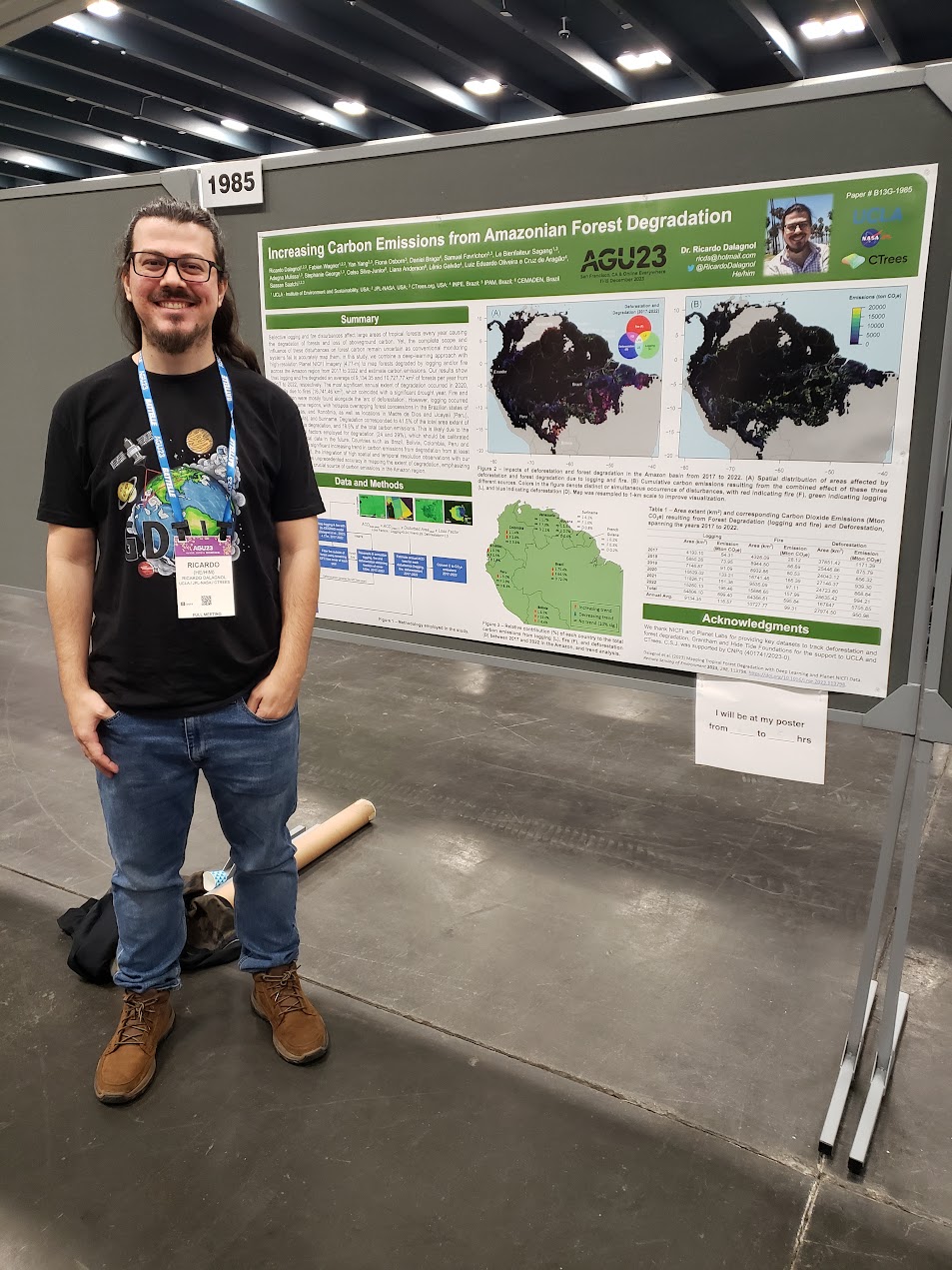
Ricardo Dalagnol presenting at AGU 2023 in San Francisco, CA, about forest degradation mapping with deep learning Ricardo Dalagnol during fieldwork in Jaru, Brazil Installing pressure dendrometer in Rebio Jaru, Brazil Secondary forest in Tapajós, Pará, Brazil Forest change animation in Pará, Brazil Deforestation animation in Tocantins, Brazil Measuring tree growth in Bananal Island, Tocantins, Brazil Campsite at Rio Javaés in Bananal Island, Tocantins, Brazil Installing soil moisture equipment at Manaus K34 tower, Brazil

Ricardo presenting at AGU 2023 in San Francisco, CA, about forest degradation mapping with deep learning

Remote Sensing · Forest Science · Climate

Turning satellite data into Forest Intelligence.

I am a Brazilian remote sensing scientist working at the intersection of Forest and Earth Observation with a focus on Geospatial Artificial Intelligence (Geo AI), building data and models with state-of-the-art Research to help understand Tropical Forests natural and anthropogenic changes, such as deforestation and degradation, and how forests recover from disturbance.

Também atuo em português com equipes no Brasil e em outros países tropicais.
Focus areas Tropical forest dynamics, deforestation, degradation, logging, fire, carbon, dMRV, REDD+
Tools Satellite time series, LiDAR, multispectral, Machine and Deep Learning

Platform release

REDD+AI at CTrees

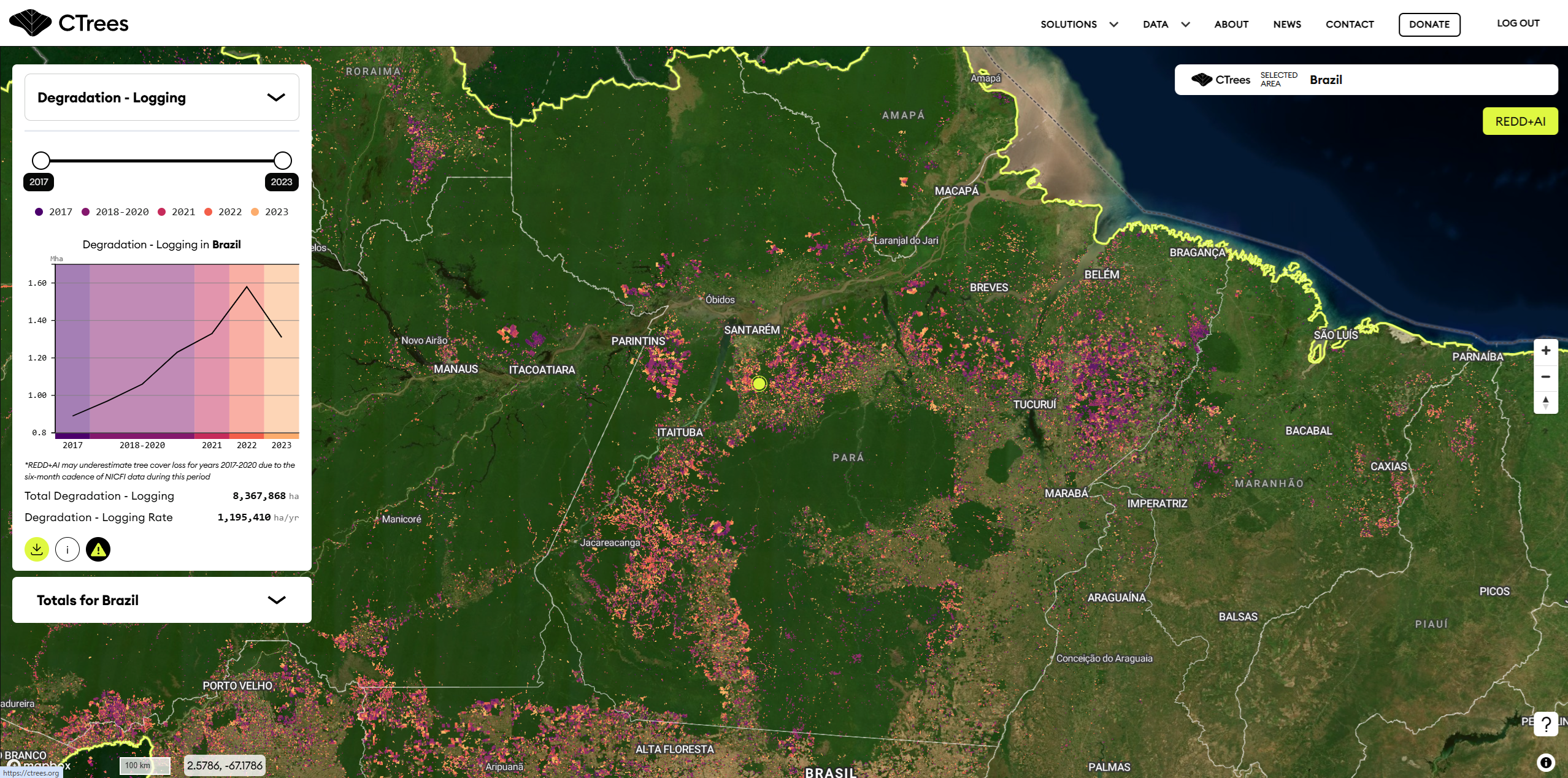
In 2024, CTrees released REDD+AI, an open platform for mapping tropical forest degradation and attributing it to logging, fire, and roads across tropical countries and subnational jurisdictions. I led the development of the activity data behind the platform, building on methods from Dalagnol et al. (2023) and collaborative work in Wagner et al. (2023).

Explore REDD+AI

Research highlights

Recent highlight

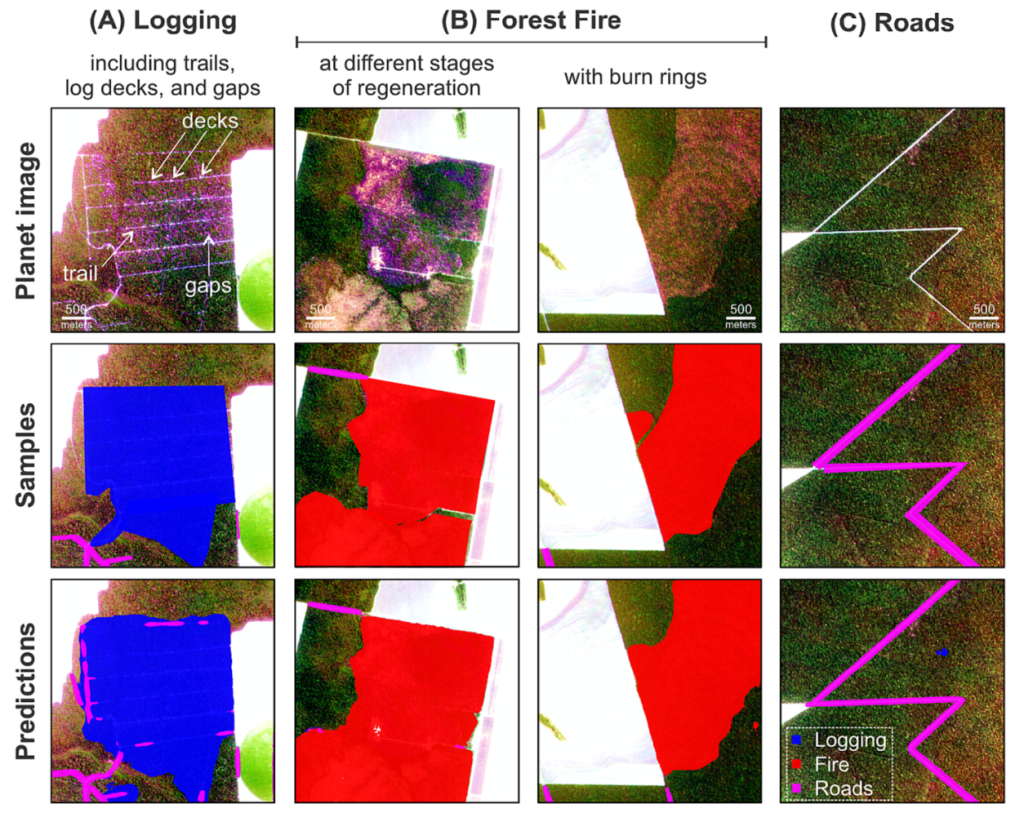
Mapping tropical forest degradation with deep learning and Planet NICFI data

Mapping tropical forest degradation with deep learning and Planet NICFI data

First wall-to-wall, high-resolution mapping of tropical forest degradation using NICFI imagery and deep learning, turning subtle canopy damage into measurable, actionable signals.

Read the paper
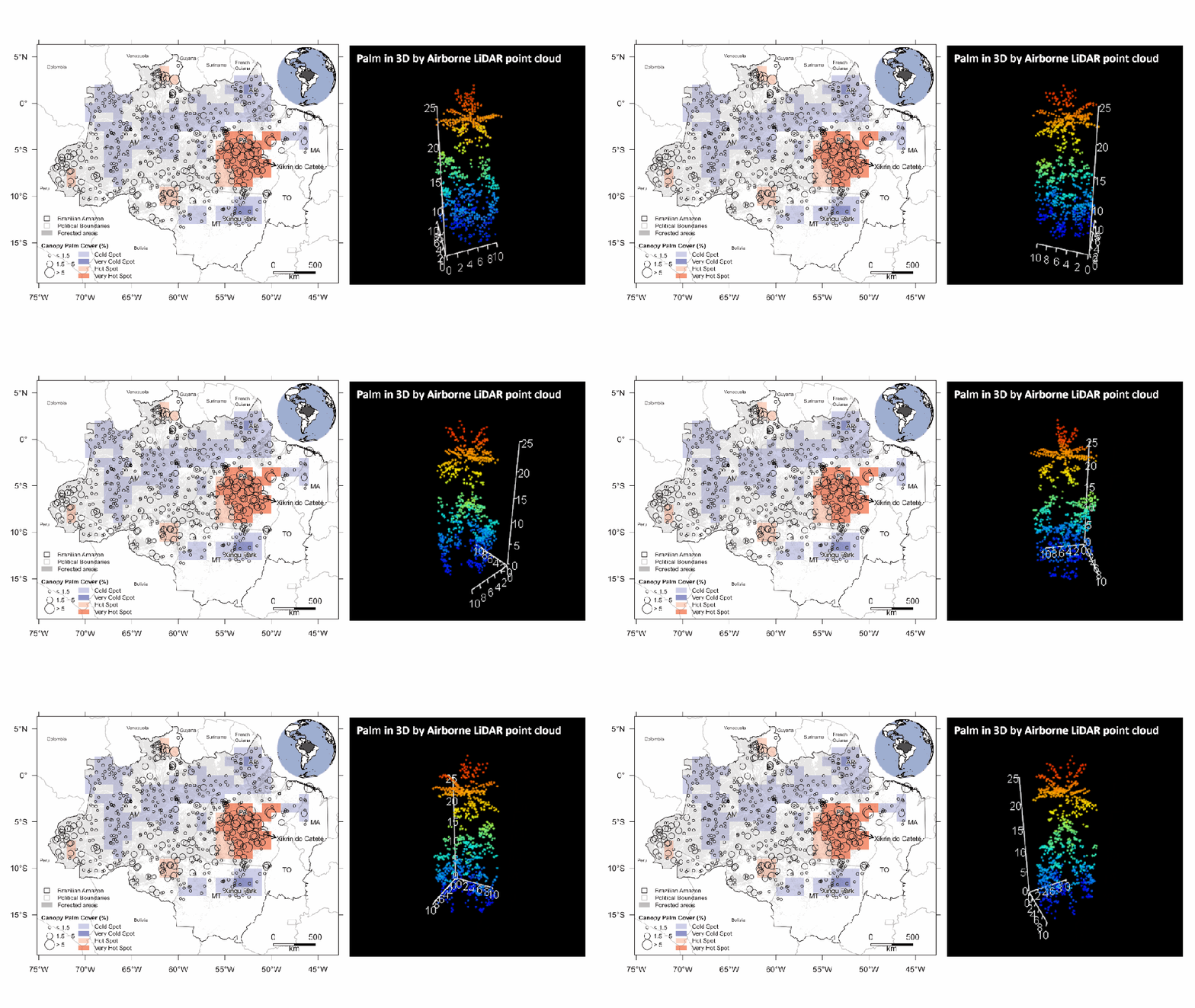
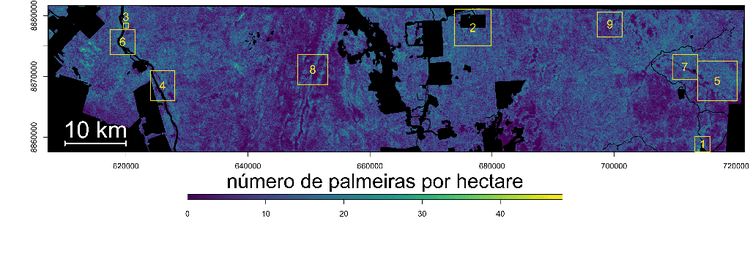
Canopy palm cover across the Brazilian Amazon forests mapped with airborne LiDAR data and deep learning

Canopy palm cover across the Brazilian Amazon forests mapped with airborne LiDAR data and deep learning

Combines airborne LiDAR and deep learning to map palm dominance across the Amazon—revealing forest structure and biodiversity signals at unprecedented scale.

Read the paper

If you wish to discuss a project please contact me by email through the Contact page.

About

I am passionate about studying forests through the lenses of remote sensing (RS) and uncovering what we can see from above the forest canopy.

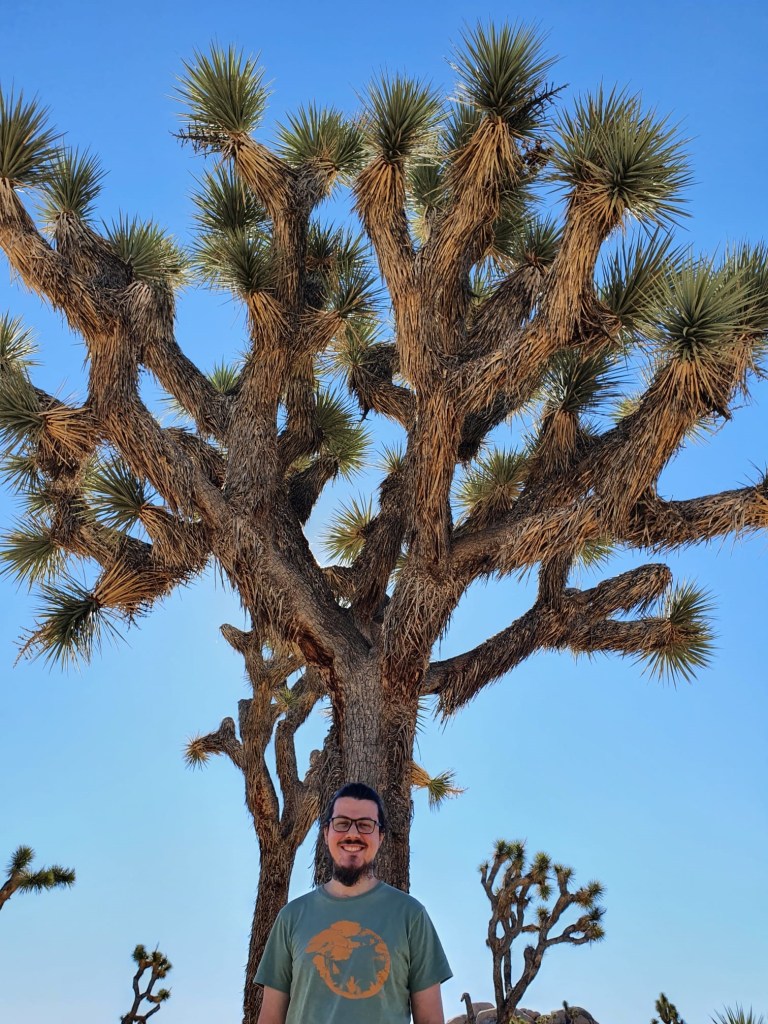
Joshua Tree National Park in the Mojave Desert

Joshua Tree National Park, California, 2022

This picture is not a tropical forest (off course), but this is nearby where I am living right now in Pasadena, CA, at Joshua Tree National Park in the Mojave Desert. Very hot but astonishing place! Almost outworldly

Profile

I am a Remote Sensing Scientist with an interdisciplinary background in environmental sciences, tropical ecology, and forest systems. My work integrates high-resolution Earth Observation data—particularly airborne LiDAR—with advanced analytical approaches, including machine learning and deep learning, to extract precise and novel insights from complex environmental systems.

My research focuses on forest dynamics, biogeosciences, and the carbon cycle. I investigate how environmental and climate change influence tropical forest ecosystems, and I develop quantitative methods that combine remote sensing and field data to improve the monitoring of forest structure, degradation, and carbon stocks.

I have strong analytical and programming expertise, with an emphasis on rigorous, empirical, and reproducible research. My work bridges ecological theory, geospatial data science, and computational modeling to generate actionable information for climate mitigation and forest conservation.

I am currently a Research Scientist at CTrees (California), where I develop and apply advanced remote sensing and machine learning methods to support high-integrity forest carbon accounting and large-scale monitoring initiatives.

I completed my postdoctoral appointment at UCLA in 2024 and then joined CTrees as Research Scientist and Activity Data Science Lead.

I welcome opportunities for scientific collaboration and interdisciplinary research. Please feel free to get in touch via email.

Work

  • 2024– Research Scientist and Activity Data Science Lead, CTrees (California, USA)
  • 2022–2024 Post-doctoral Researcher, Institute of the Environment and Sustainability, UCLA (Los Angeles, USA)
  • 2022–2024 Research Affiliate, NASA-Jet Propulsion Laboratory, California Institute of Technology (Pasadena, USA)
  • 2021–2024 Honorary Research Fellow, University of Manchester (Manchester, UK)
  • 2020–2022 Post-doctoral Researcher, DIOTG/INPE (São José dos Campos, Brazil)
  • 2018–2019 Visiting Researcher (PhD Remote Sensing), University of Leeds (Leeds, UK)
  • 2014–2016 Research Assistant, DIAV/INPE (São José dos Campos, Brazil)

Education

  • 2016–2020 PhD in Remote Sensing, DIOTG/INPE (São José dos Campos, Brazil)
  • 2012–2014 MSc in Remote Sensing, DIOTG/INPE (São José dos Campos, Brazil)
  • 2008–2011 BSc. in Forest Engineering (interrupted to start the MSc), UTFPR (Dois Vizinhos, Brazil)
  • 2007–2011 BSc. in Environmental Engineering, UNISEP (Dois Vizinhos, Brazil)

Research field

  • Remote sensing
  • Tropical ecology
  • Forest dynamics
  • Amazonia
  • Biomass
  • Plant species distribution
  • Deep learning
  • dMRV
  • REDD+

Research & Development

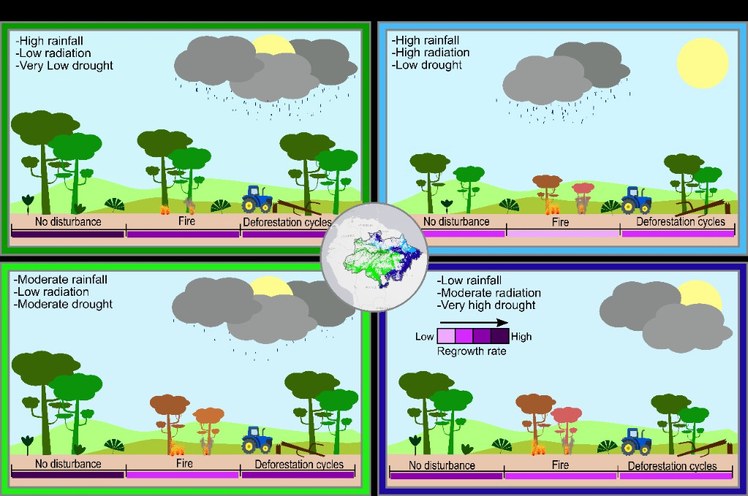
Assessing the Impacts of Environmental and Climate Change in the Tropics

Advancing Tropical Ecology using Remote Sensing

Development of Remote Sensing Data and Artificial Intelligence Methods to Advance Earth Observation

Applied REDD+ and dMRV development

Beyond peer-reviewed publications, I lead applied technical work that turns remote sensing, AI, and forest carbon methods into operational datasets for jurisdictional REDD+ and dMRV programs.

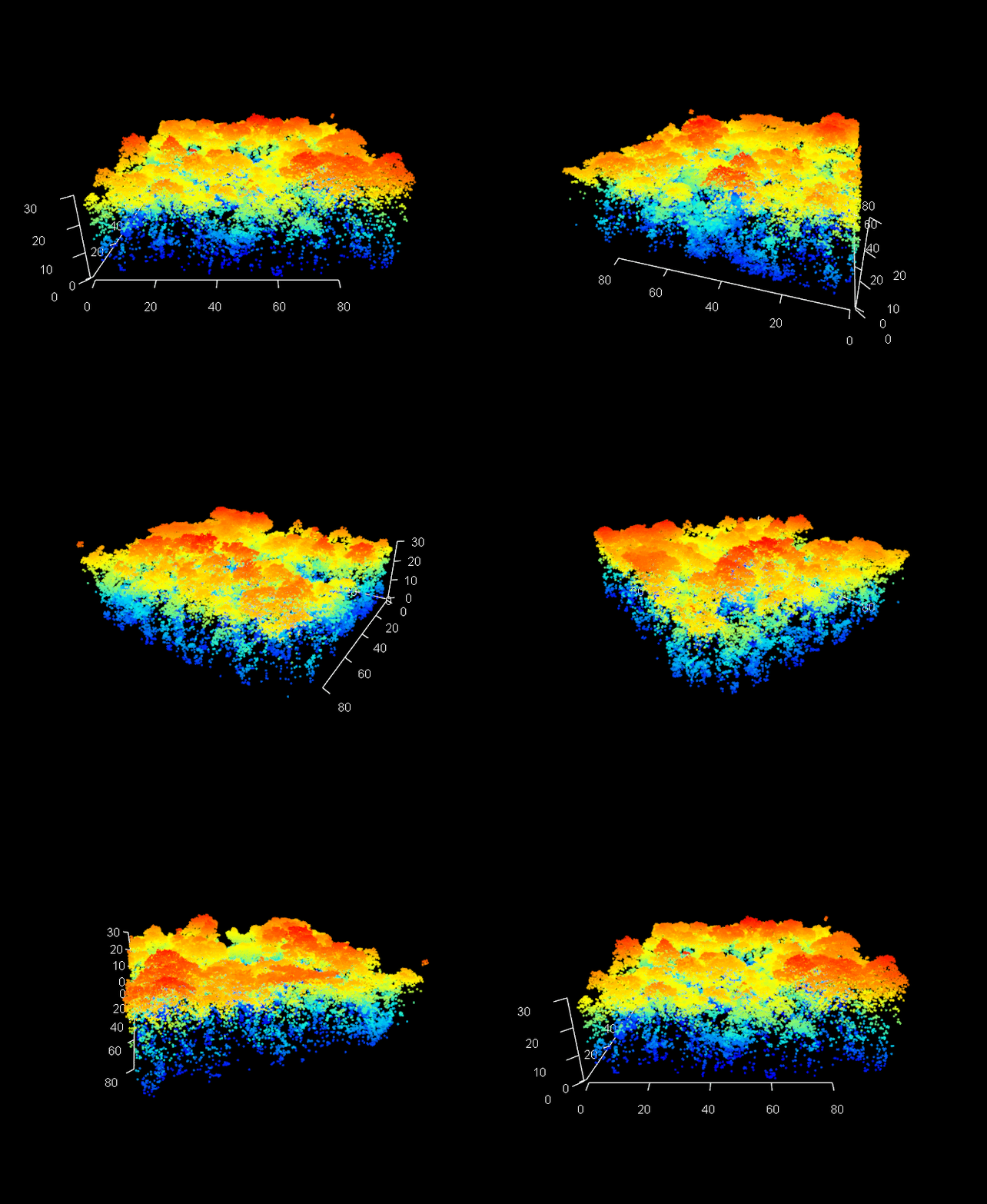
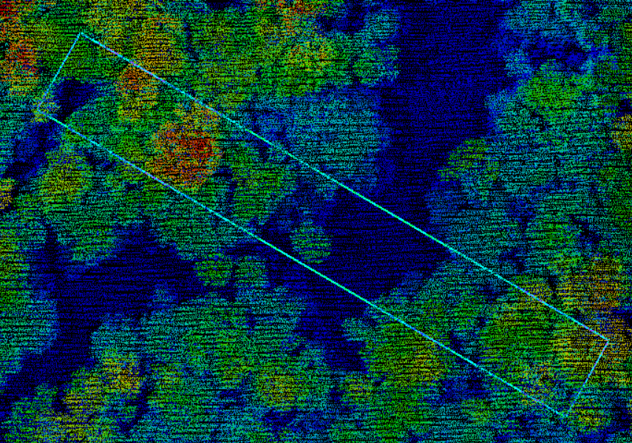
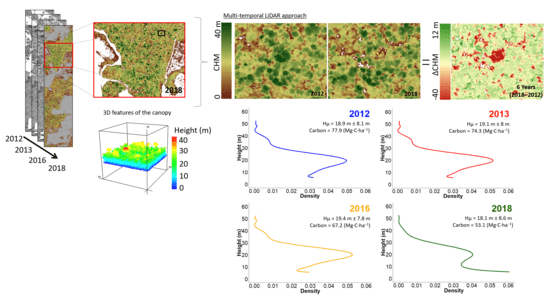
Rotating visualization of forest structure

Technical reports

  • Dalagnol, Ricardo, et al. (2024). Forest Cover Benchmark Maps and Activity Data to Support VM0048 Implementation across 6 Tropical Jurisdictions in 3 Countries. Lead author. Report prepared for Verra VCS.
  • Dalagnol, Ricardo, et al. (2025). Forest Cover Benchmark Maps and Activity Data to Support VM0048 Implementation across 36 Tropical Jurisdictions in 16 Countries. Lead author. Report prepared for Verra VCS.
  • Dalagnol, Ricardo, et al. (2024-2026). Due-diligence dMRV assessments for 10 ART-TREES and FCPF jurisdictional REDD+ opportunities. Lead technical development integrating activity data, remote sensing diagnostics, and geospatial quality checks for buyer-side evaluation of jurisdictional forest carbon performance.

Full list of publications

2026

  • Yang, Yan; et al. (2026). From Snapshot Maps to Continuous Monitoring of Global Forest Carbon at 100 m Resolution (2000–2025). EarthArXiv. URL: https://eartharxiv.org/repository/view/12941/.
  • Natel, Carolina; et al. (2026). Deep Learning for Satellite‐Based Forest Disturbance Monitoring: Recent Advances and Challenges. WIREs Data Mining and Knowledge Discovery, 16(2), e70096. DOI: https://doi.org/10.1002/widm.70096.
  • Li, Chuanze; et al. (2026). Disturbance and incomplete recovery in the Cerrado-Amazon transition: Implications for conservation of a critical tropical ecotone. Biological Conservation, 319, 111900. DOI: https://doi.org/10.1016/j.biocon.2026.111900.
  • Fernandes, Helen Giovanna Pereira; et al. (2026). Land Use and Land Cover Dynamics and Their Association with Fire in Indigenous Territories of Maranhão, Brazil (1985–2023). Land, 15(1), 132. DOI: https://doi.org/10.3390/land15010132.
  • Dutra, Débora J.; et al. (2026). Dry‐Season Water Deficits in the Southwestern Amazon Under High Emissions. International Journal of Climatology, e70331. DOI: https://doi.org/10.1002/joc.70331.
  • Braga, Daniel; et al. (2026). Monitoring sustainable logging in an Amazon forest under management using deep learning and Planet NICFI imagery. International Journal of Remote Sensing, 47(3), 1287--1312. DOI: https://doi.org/10.1080/01431161.2025.2603696.

2025

  • Zhu, Lei; et al. (2025). Spatially varying parameters improve carbon cycle modeling in the Amazon rainforest with ORCHIDEE r8849. Geoscientific Model Development. DOI: https://doi.org/10.5194/egusphere-2025-397.
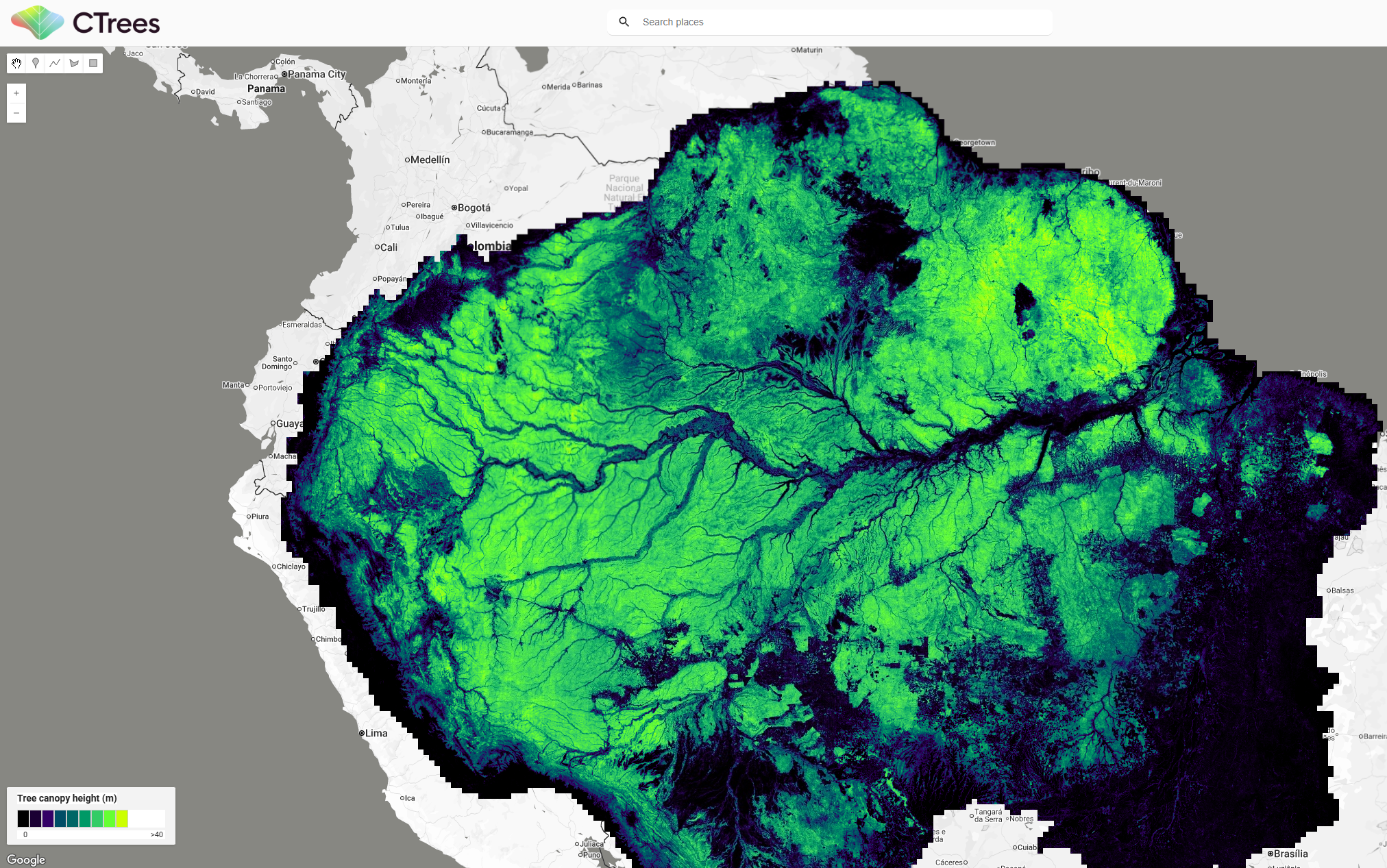
  • Wagner, Fabien H.; et al. (2025). Wall‐to‐wall Amazon forest height mapping with Planet NICFI, Aerial LiDAR, and a U‐Net regression model. Remote Sensing in Ecology and Conservation, rse2.70041. DOI: https://doi.org/10.1002/rse2.70041.
  • Wagner, Fabien H.; et al. (2025). Monitoring the Early Growth of Pinus and Eucalyptus Plantations Using a Planet NICFI-Based Canopy Height Model: A Case Study in Riqueza, Brazil. Remote Sensing, 17(15), 2718. DOI: https://doi.org/10.3390/rs17152718.
  • Vedovato, Laura B.; et al. (2025). Impacts of fire on canopy structure and its resilience depend on successional stage in Amazonian secondary forests. Remote Sensing in Ecology and Conservation, rse2.431. DOI: https://doi.org/10.1002/rse2.431.
  • Network, International; et al. (2025). Towards a global understanding of tree mortality. New Phytologist. DOI: https://doi.org/10.1111/nph.20407.
  • Favrichon, Samuel; et al. (2025). Monitoring changes of forest height in California. Frontiers in Remote Sensing, 5. DOI: https://doi.org/10.3389/frsen.2024.1459524.

2024

  • Winstanley, Philip; et al. (2024). Post-Logging Canopy Gap Dynamics and Forest Regeneration Assessed Using Airborne LiDAR Time Series in the Brazilian Amazon with Attribution to Gap Types and Origins. Remote Sensing, 16(13), 2319. DOI: https://doi.org/10.3390/rs16132319.
  • Wagner, Fabien H.; et al. (2024). The Amazon’s 2023 Drought: Sentinel-1 Reveals Extreme Rio Negro River Contraction. Remote Sensing, 16(6), 1056. DOI: https://doi.org/10.3390/rs16061056.
  • Wagner, Fabien H.; et al. (2024). Sub-meter tree height mapping of California using aerial images and LiDAR-informed U-Net model. Remote Sensing of Environment, 305, 114099. DOI: https://doi.org/10.1016/j.rse.2024.114099.
  • Takougoum Sagang, Le Bienfaiteur; et al. (2024). Unveiling spatial variations of high forest live biomass carbon stocks of Gabon using advanced remote sensing techniques. Environmental Research Letters, 19(7), 074038. DOI: https://doi.org/10.1088/1748-9326/ad5572.
  • Mullissa, Adugna; et al. (2024). LUCA: A Sentinel-1 SAR-Based Global Forest Land Use Change Alert. Remote Sensing, 16(12), 2151. DOI: https://doi.org/10.3390/rs16122151.
  • Jacon, Aline D.; et al. (2024). Characterizing Canopy Structure Variability in Amazonian Secondary Successions with Full-Waveform Airborne LiDAR. Remote Sensing, 16(12), 2085. DOI: https://doi.org/10.3390/rs16122085.
  • Gonçalves, Nathan Borges; et al. (2024). Revealing forest structural "fingerprints": An integration of LiDAR and deep learning uncovers topographical influences on Central Amazon forests. Ecological Informatics, 81, 102628. DOI: https://doi.org/10.1016/j.ecoinf.2024.102628.
  • Galvão, Lênio Soares; et al. (2024). Coupled effects of solar illumination and phenology on vegetation index determination: an analysis over the Amazonian forests using the SuperDove satellite constellation. GIScience & Remote Sensing, 61(1), 2290354. DOI: https://doi.org/10.1080/15481603.2023.2290354.
  • Carter, Griffin; et al. (2024). Detection of forest disturbance across California using deep-learning on PlanetScope imagery. Frontiers in Remote Sensing, 5, 1409400. DOI: https://doi.org/10.3389/frsen.2024.1409400.
  • Breunig, Fábio Marcelo; et al. (2024). Monitoring Cover Crop Biomass in Southern Brazil Using Combined PlanetScope and Sentinel-1 SAR Data. Remote Sensing, 16(15), 2686. DOI: https://doi.org/10.3390/rs16152686.

2023

  • de Abreu Araújo, Juliana; et al. (2023). Sensitivity of hyperspectral vegetation indices to rainfall seasonality in the Brazilian savannahs: an analysis using PRISMA data. Remote Sensing Letters, 14(3), 277--287. DOI: https://doi.org/10.1080/2150704x.2023.2189031.
  • Wagner, Fabien H.; et al. (2023). Mapping Tropical Forest Cover and Deforestation with Planet NICFI Satellite Images and Deep Learning in Mato Grosso State (Brazil) from 2015 to 2021. Remote Sensing, 15(2), 521. DOI: https://doi.org/10.3390/rs15020521.
  • Ping, Dazhou; et al. (2023). Assessing the Magnitude of the Amazonian Forest Blowdowns and Post-Disturbance Recovery Using Landsat-8 and Time Series of PlanetScope Satellite Constellation Data. Remote Sensing, 15(12), 3196. DOI: https://doi.org/10.3390/rs15123196.
  • Klauberg, Carine; et al. (2023). Post-Hurricane Damage Severity Classification at the Individual Tree Level Using Terrestrial Laser Scanning and Deep Learning. Remote Sensing.
  • Heinrich, Viola H. A.; et al. (2023). The carbon sink of secondary and degraded humid tropical forests. Nature, 615(7952), 436--442. DOI: https://doi.org/10.1038/s41586-022-05679-w.
  • Gonçalves, Nathan B.; et al. (2023). Amazon forest spectral seasonality is consistent across sensor resolutions and driven by leaf demography. ISPRS Journal of Photogrammetry and Remote Sensing, 196, 93--104. DOI: https://doi.org/10.1016/j.isprsjprs.2022.12.001.
  • Ferla, Andressa Kossmann; et al. (2023). Mapping Pinus spp. Forestry and Land Cover Classes Using High-resolution PlanetScope Satellite Data: Experimenting Images from Different Seasons and Machine Learning Methods. Revista Brasileira de Cartografia, 75, 1--14. DOI: https://doi.org/http://dx.doi.org/10.14393/rbcv75n0a-67769.
  • Dutra, Débora Joana; et al. (2023). Fire Dynamics in an Emerging Deforestation Frontier in Southwestern Amazonia, Brazil. Fire, 6(1), 2. DOI: https://doi.org/10.3390/fire6010002.
  • Dutra, Débora Joana; et al. (2023). Burned area mapping in Different Data Products for the Southwest of the Brazilian Amazon. Revista Brasileira de Cartografia, 75. DOI: https://doi.org/10.14393/rbcv75n0a-68393.
  • Dalagnol, Ricardo; et al. (2023). Mapping tropical forest degradation with deep learning and Planet NICFI data. Remote Sensing of Environment, 298, 113798. DOI: https://doi.org/10.1016/j.rse.2023.113798.
  • Dalagnol, Ricardo; et al. (2023). AnisoVeg: anisotropy and nadir-normalized MODIS multi-angle implementation atmospheric correction (MAIAC) datasets for satellite vegetation studies in South America. Earth System Science Data, 15(1), 345--358. DOI: https://doi.org/10.5194/essd-15-345-2023.
  • Da Conceição Bispo, Polyanna; et al. (2023). Overlooking vegetation loss outside forests imperils the Brazilian Cerrado and other non-forest biomes. Nature Ecology & Evolution. DOI: https://doi.org/10.1038/s41559-023-02256-w.
  • Crivelari-Costa, Patrícia Monique; et al. (2023). Changes in Carbon Dioxide Balance Associated with Land Use and Land Cover in Brazilian Legal Amazon Based on Remotely Sensed Imagery. Remote Sensing, 15(11). DOI: https://doi.org/10.3390/rs15112780.
  • Araújo, Juliana De Abreu; et al. (2023). Evaluating changes with vegetation cover in PRISMA's spectral, spatial, and temporal attributes and their performance for classifying savannahs in Brazil. Remote Sensing Applications: Society and Environment, 32, 101074. DOI: https://doi.org/10.1016/j.rsase.2023.101074.

2022

  • Wagner, Fabien H.; et al. (2022). K-textures, a self-supervised hard clustering deep learning algorithm for satellite image segmentation. Frontiers in Environmental Science, 10, 1--19. DOI: https://doi.org/10.3389/fenvs.2022.946729.
  • Wagner, Fabien H.; et al. (2022). Fast computation of digital terrain model anomalies based on LiDAR data for geoglyph detection in the Amazon. Remote Sensing Letters, 13(9), 935--945. DOI: https://doi.org/10.1080/2150704X.2022.2109942.
  • Reis, Cristiano Rodrigues; et al. (2022). Forest disturbance and growth processes are reflected in the geographical distribution of large canopy gaps across the Brazilian Amazon. Journal of Ecology, 110(12), 2971--2983. DOI: https://doi.org/10.1111/1365-2745.14003.
  • Pontes-Lopes, Aline; et al. (2022). Quantifying Post-Fire Changes in the Aboveground Biomass of an Amazonian Forest Based on Field and Remote Sensing Data. Remote Sensing, 14(7), 1545. DOI: https://doi.org/10.3390/rs14071545.
  • Petri, Caio Arlanche; et al. (2022). Solar illumination effects on the dry-season variability of spectral and spatial attributes calculated from PlanetScope data over tropical forests of the Amazon. International Journal of Remote Sensing, 43(11), 4087--4116. DOI: https://doi.org/10.1080/01431161.2022.2106801.
  • Mataveli, Guilherme; et al. (2022). Science‐based planning can support law enforcement actions to curb deforestation in the Brazilian Amazon. Conservation Letters, 1--9. DOI: https://doi.org/10.1111/conl.12908.
  • Haddad, Isadora; et al. (2022). On the combined use of phenological metrics derived from different PlanetScope vegetation indices for classifying savannas in Brazil. Remote Sensing Applications: Society and Environment, 26, 100764. DOI: https://doi.org/10.1016/j.rsase.2022.100764.
  • Ferreira Barbosa, Maria Lucia; et al. (2022). Compound impact of land use and extreme climate on the 2020 fire record of the Brazilian Pantanal. Global Ecology and Biogeography, 1--16. DOI: https://doi.org/10.1111/geb.13563.
  • Dalagnol, Ricardo; et al. (2022). Canopy palm cover across the Brazilian Amazon forests mapped with airborne LiDAR data and deep learning. Remote Sensing in Ecology and Conservation, 1--14. DOI: https://doi.org/10.1002/rse2.264.

2021

  • Zhang, Huixian; et al. (2021). Forest Canopy Changes in the Southern Amazon during the 2019 Fire Season Based on Passive Microwave and Optical Satellite Observations. Remote Sensing, 13(12), 2238. DOI: https://doi.org/10.3390/rs13122238.
  • Silva, Celso H. L.; et al. (2021). Surviving as a young scientist in Brazil. Science, 374(6570), 948--948. DOI: https://doi.org/10.1126/science.abm8160a.
  • Pontes-Lopes, Aline; et al. (2021). Drought-driven wildfire impacts on structure and dynamics in a wet Central Amazonian forest. Proceedings of the Royal Society B: Biological Sciences, 288(1951), 20210094. DOI: https://doi.org/10.1098/rspb.2021.0094.
  • Kuck, Tahisa Neitzel; et al. (2021). Change Detection of Selective Logging in the Brazilian Amazon Using X-Band SAR Data and Pre-Trained Convolutional Neural Networks. Remote Sensing, 13(23), 4944. DOI: https://doi.org/10.3390/rs13234944.
  • Jacon, Aline Daniele; et al. (2021). Aboveground biomass estimates over Brazilian savannas using hyperspectral metrics and machine learning models: experiences with Hyperion/EO-1. GIScience & Remote Sensing, 1--18. DOI: https://doi.org/10.1080/15481603.2021.1969630.
  • Heinrich, Viola H A; et al. (2021). Large carbon sink potential of secondary forests in the Brazilian Amazon to mitigate climate change. Nature Communications, 12(1), 1785. DOI: https://doi.org/10.1038/s41467-021-22050-1.
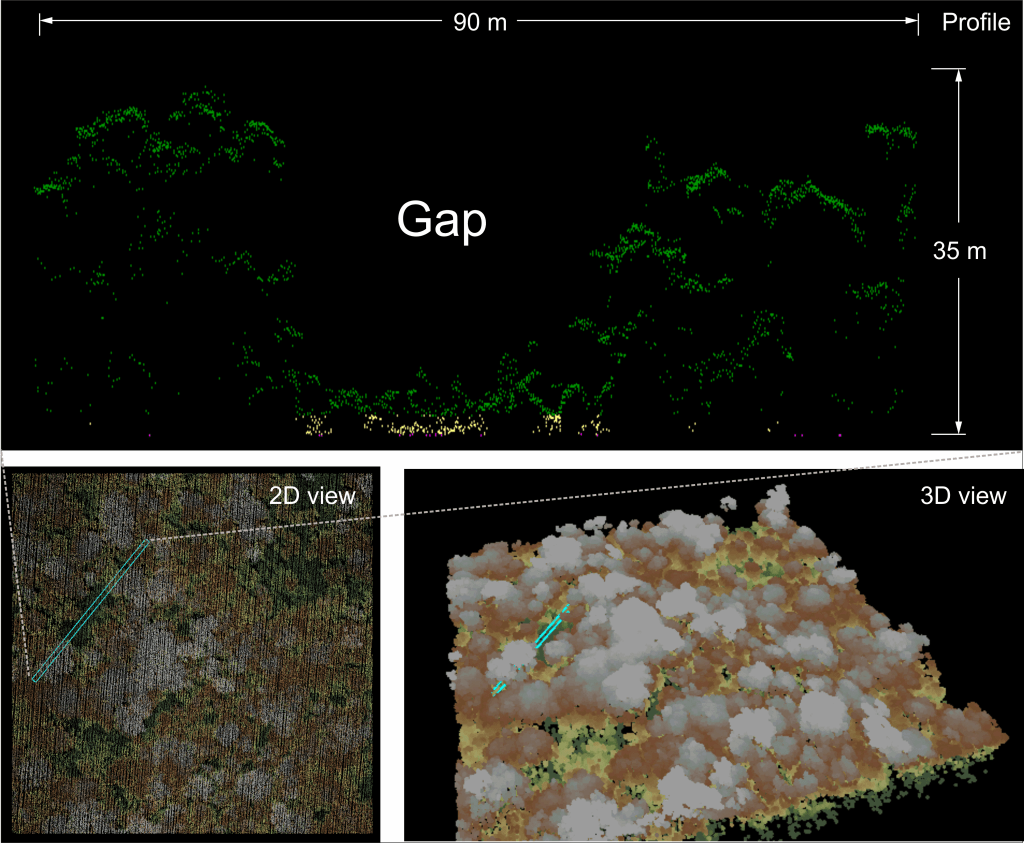
  • Dalagnol, Ricardo; et al. (2021). Large-scale variations in the dynamics of Amazon forest canopy gaps from airborne lidar data and opportunities for tree mortality estimates. Scientific Reports, 11(1), 1388. DOI: https://doi.org/10.1038/s41598-020-80809-w.
  • Dalagnol, Ricardo; et al. (2021). Extreme rainfall and its impacts in the Brazilian Minas Gerais state in January 2020: Can we blame climate change. Climate Resilience and Sustainability, 1-5. DOI: https://doi.org/10.1002/cli2.15.

2020

  • Wagner, Fabien H.; et al. (2020). U-net-id, an instance segmentation model for building extraction from satellite images-Case study in the Joanopolis City, Brazil. Remote Sensing, 12(10), 1--14. DOI: https://doi.org/10.3390/rs12101544.
  • Wagner, Fabien H; et al. (2020). Regional Mapping and Spatial Distribution Analysis of Canopy Palms in an Amazon Forest Using Deep Learning and VHR Images. Remote Sensing, 12(14), 2225. DOI: https://doi.org/10.3390/rs12142225.
  • Moura, Yhasmin Mendes De; et al. (2020). Carbon Dynamics in a Human-Modified Tropical Forest: A Case Study Using Multi-Temporal LiDAR Data. Remote Sensing, 12(3), 430. DOI: https://doi.org/10.3390/rs12030430.
  • Gonçalves, Nathan Borges; et al. (2020). Both near-surface and satellite remote sensing confirm drought legacy effect on tropical forest leaf phenology after 2015/2016 ENSO drought. Remote Sensing of Environment, 237, 111489. DOI: https://doi.org/10.1016/j.rse.2019.111489.
  • Breunig, Fábio Marcelo; et al. (2020). Assessing the effect of spatial resolution on the delineation of management zones for smallholder farming in southern Brazil. Remote Sensing Applications: Society and Environment, 19. DOI: https://doi.org/10.1016/j.rsase.2020.100325.
  • Breunig, Fábio; et al. (2020). Delineation of management zones in agricultural fields using cover-crop biomass estimates from PlanetScope data. Int J Appl Earth Obs Geoinformation, 85, 102004. DOI: https://doi.org/10.1016/j.jag.2019.102004.
  • Braga, José R G; et al. (2020). Tree Crown Delineation Algorithm Based on a Convolutional Neural Network. Remote Sensing, 12(8), 1--27. DOI: https://doi.org/10.3390/rs12081288.
  • Bontempo, Edgard; et al. (2020). Adjustments to sif aid the interpretation of drought responses at the caatinga of Northeast Brazil. Remote Sensing, 12(19), 1--29. DOI: https://doi.org/10.3390/rs12193264.

2019

  • Silva Junior, Celso H. L.; et al. (2019). Fire Responses to the 2010 and 2015/2016 Amazonian Droughts. Frontiers in Earth Science, 7, 1--16. DOI: https://doi.org/10.3389/feart.2019.00097.
  • Fonseca, Letícia D. M.; et al. (2019). Phenology and Seasonal Ecosystem Productivity in an Amazonian Floodplain Forest. Remote Sensing, 11(13), 1530. DOI: https://doi.org/10.3390/rs11131530.
  • Debastiani, Aline Bernarda; et al. (2019). Árvore Modelo Frente a Uma Rede Neural Artificial Para a Modelagem Chuva-Vazão. Nativa, 7(5), 527. DOI: https://doi.org/10.31413/nativa.v7i5.7089.
  • Dalagnol, Ricardo; et al. (2019). Quantifying Canopy Tree Loss and Gap Recovery in Tropical Forests under Low-Intensity Logging Using VHR Satellite Imagery and Airborne LiDAR. Remote Sensing, 11(7), 817. DOI: https://doi.org/10.3390/rs11070817.

2018

  • Dalagnol, Ricardo; et al. (2018). Life cycle of bamboo in the southwestern Amazon and its relation to fire events. Biogeosciences, 15(20), 6087--6104. DOI: https://doi.org/10.5194/bg-15-6087-2018.
  • Anderson, Liana Oighenstein; et al. (2018). Vulnerability of Amazonian forests to repeated droughts. Philosophical Transactions of the Royal Society B: Biological Sciences, 373(1760), 20170411. DOI: https://doi.org/10.1098/rstb.2017.0411.

2017

  • Dalagnol, Ricardo; et al. (2017). Assessment of climate change impacts on water resources of the Purus Basin in the southwestern Amazon. Acta Amazonica, 213(2017), 213--226. DOI: https://doi.org/10.1590/1809-4392201601993.

2016

  • Silva, Camila Valéria de Jesus; et al. (2016). Floristic and structure of an Amazonian primary forest and a chronosequence of secondary succession. Acta Amazonica, 46(2), 133--150. DOI: https://doi.org/10.1590/1809-4392201504341.
  • Mateus, Pedro; et al. (2016). Assessment of two techniques to merge ground-based and TRMM rainfall measurements: a case study about Brazilian Amazon Rainforest. GIScience & Remote Sensing, 53(6), 689--706. DOI: https://doi.org/10.1080/15481603.2016.1228161.
  • Debastiani, Aline Bernarda; et al. (2016). Eficácia da arquitetura MLP em modo closed-loop para simulação de um Sistema Hidrológico. RBRH, 21(4), 821--831. DOI: https://doi.org/10.1590/2318-0331.011615124.

2015

  • Galvão, Lênio Soares; et al. (2015). Following a site-specific secondary succession in the Amazon using the Landsat CDR product and field inventory data. International Journal of Remote Sensing, 37--41. DOI: https://doi.org/10.1080/01431161.2014.999879.
  • Debastiani, Aline Bernarda; et al. (2015). Assessment of Climatological Variables for Daily Evapotranspiration Modelling Using Artificial Neural Networks: Case Study on Brazilian State of Santa Catarina. Australian Journal of Basic and Applied Sciences, 9, 328--333. URL: http://www.ajbasweb.com/old/ajbas/2015/December/328-333.pdf.

2014

  • Silva, Ricardo D; et al. (2014). Spectral / textural attributes from ALI / EO-1 for mapping primary and secondary tropical forests and studying the relationships with biophysical parameters. GIScience & Remote Sensing, 37--41. DOI: https://doi.org/10.1080/15481603.2014.972866.

Teaching & Supervision

Courses, workshops, invited lectures, and student mentorship.

Teaching

  • Video
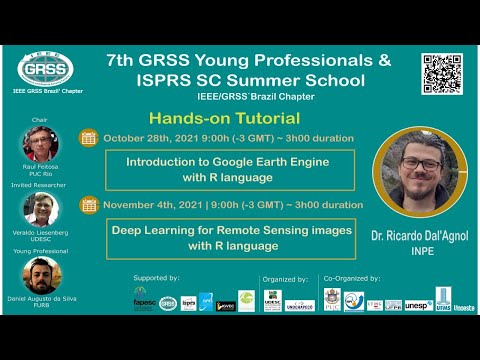
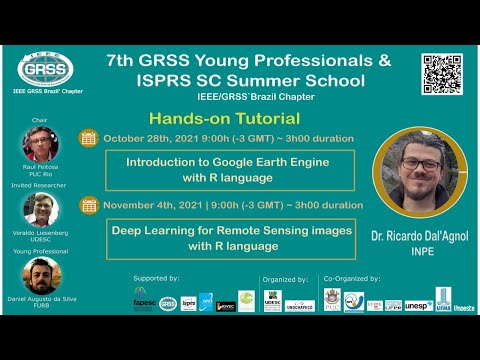
    2021 · Short course “Deep Learning for Remote Sensing images with R language” IEEE GRSS-ISPRS SC 2021 – http://grss-isprs.udesc.br/ · Recording: https://youtu.be/N3CHgRlRqOA
  • Video
    2021 · Short course “Introduction to Google Earth Engine with R language” IEEE GRSS-ISPRS SC 2021 – http://grss-isprs.udesc.br/ · Recording: https://youtu.be/SHXuIpjU3YE
  • Course
    2021 · 60h Course “Special Topics in Spatio-temporal data analysis” Postgraduate program of Environmental Science and Technology (PPGCTA), Federal University of Santa Maria (UFSM), Brazil
  • Video
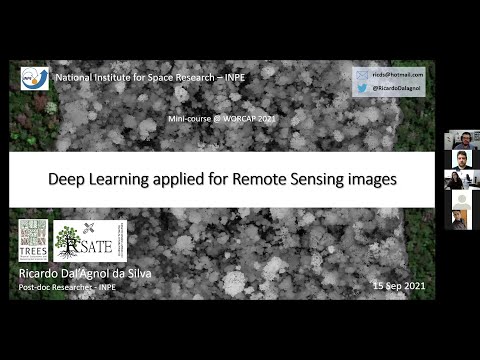
    2021 · Mini-course “Deep Learning para Imagens de Sensoriamento Remoto” WorCAP 2021 – http://www.inpe.br/worcap/2021/ · Recording: https://youtu.be/foRhRg6VaCQ
  • Lecture
    2021 · Lecture “Lidar data applied for landscape ecology and vegetation studies” Introduction to Landscape Ecology and Remote Sensing – BSc Geography – University of Manchester, UK
  • Lecture
    2021 · Lecture “Neural networks with geospatial data” Special Topics in Artificial Intelligence: machine learning with geographical data – BSc Cartography – Federal Institute of Goiás (IFG), Brazil
  • Lecture
    2020 · Lecture “Introduction to Airborne LiDAR data for vegetation studies” Forest and Biogeography course – MSc/PhD Remote Sensing – INPE, Brazil
  • Lecture
    2020 · Lecture “Introduction to remote sensing time series analysis for vegetation studies” Forest and Biogeography course – MSc/PhD Remote Sensing – INPE, Brazil

Supervision

Supervision: 2 PhD, 11 MSc, and 3 undergraduate/BSc projects across Brazil and the UK.

Current

  • PhD
    Forest structure and biomass estimates in tropical human-modified agroforestry systems in the Brazilian state of Bahia L. Daltro · PhD Ecology and Conservation of Biodiversity, UESC, Brazil · 2025-current

Finished

PhD

  • PhD
    The use of full-waveform LiDAR data to study the structural heterogeneity of secondary forests in the Brazilian Amazon: successional trajectories and conditioning factors A. Jacon · PhD Remote Sensing, INPE, Brazil · 2021

MSc

  • MSc
    Monitoring of forest management and degradation in federal forest concessions in the Brazilian Amazon using remote sensing D. Braga · MSc Remote Sensing, INPE, Brazil
  • MSc
    Detectability of forest fires in the Brazilian Amazon using satellite images Bo Yao · MSc Geographical Information Science, University of Manchester, UK · 2023
  • MSc
    Hyperspectral time series to study savannah Cerrado vegetation J. Araujo · MSc Remote Sensing, INPE, Brazil · 2021-2023
  • MSc
    Blowdown disturbances in the Amazon forests analysed using Landsat-8 and Planet satellite data: detection and post-disturbance recovery Dazhou Ping · MSc Geographical Information Science, University of Manchester, UK · 2022
  • MSc
    Tracking logging disturbances in the Amazon forests (Mato Grosso) supported by daily time series of high-resolution Planet satellite imagery Kexin Peng · MSc Geographical Information Science, University of Manchester, UK · 2022
  • MSc
    Using high-resolution optical remote sensing imagery to detect artisanal small-scale gold mining (ASGM) activity within Indigenous Lands, Brazilian Amazon Emily Goldsmith · MSc Geographical Information Science, University of Manchester, UK · 2022
  • MSc
    Mapping tree species in the tropical forests of Brazil and Argentina using high-resolution Planet satellite images and machine learning Chen Guo · MSc Geographical Information Science, University of Manchester, UK · 2022
  • MSc
    Landscape and above-ground biomass dynamics of Brazilian Savanna using airborne LiDAR and MapBiomas datasets: case study of Rio Vermelho Watershed, Brazil C. Lee · MSc Geographical Information Science, University of Manchester, UK · 2021
  • MSc
    Assessment of tropical forests canopy gap dynamics and forest regeneration using airborne LiDAR time series in the Brazilian Amazon P. Winstanley · MSc Geographical Information Science, University of Manchester, UK · 2021
  • MSc
    Very high resolution remote sensing and deep learning applied for the segmentation of river-houses within the Negro River in the Manaus city region Y. Zhang · MSc Geographical Information Science, University of Manchester, UK · 2021
  • MSc
    Forest degradation effects in Brazilian Amazon with repeated airborne LiDAR data Z. Cai · MSc Geographical Information Science, University of Manchester, UK · 2021

Undergraduate / BSc

  • BSc
    Mapping forest degradation in the Brazilian Amazon with high-resolution images and artificial intelligence: a case study in the Jamari National Forest D. Braga · Undergraduate BSc. Geography, UFSC, Brazil · 2021
  • BSc
    Deep Learning for Palm Segmentation with Airborne LiDAR data L. Nogueira · Undergraduate at Military Engineering Institute, IME, Brazil · 2022
  • BSc
    São Paulo's black rain in 2019: to what extent Amazon fires can affect other regions? J. Fonseca · Undergraduate BSc. Environmental Engineering, UNIFEI, Brazil · 2020-2021

Media & Outreach

Articles, interviews, short courses, and public-facing work.

  • Watch
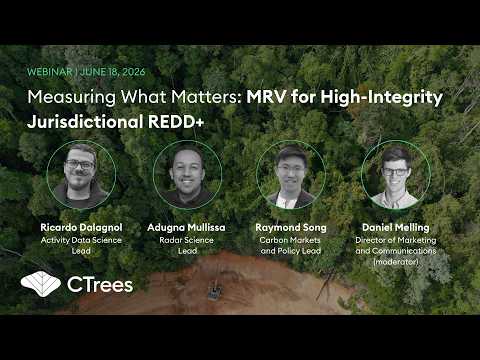
    Jun 2026 · Webinar | Measuring What Matters: CTrees MRV for High-Integrity JREDD+ youtube.com/watch?v=Qbsc-rGQc5E
  • Watch
    Nov 2021 · Short course “Deep Learning for Remote Sensing images with R language” IEEE GRSS-ISPRS SC 2021 – https://youtu.be/N3CHgRlRqOA
  • Watch
    Oct 2021 · Short course “Introduction to Google Earth Engine with R language” IEEE GRSS-ISPRS SC 2021 – https://youtu.be/SHXuIpjU3YE
  • Watch
    Sep 2021 · Mini-curso “Deep Learning para Imagens de Sensoriamento Remoto” WorCAP 2021 – https://youtu.be/foRhRg6VaCQ
  • Read
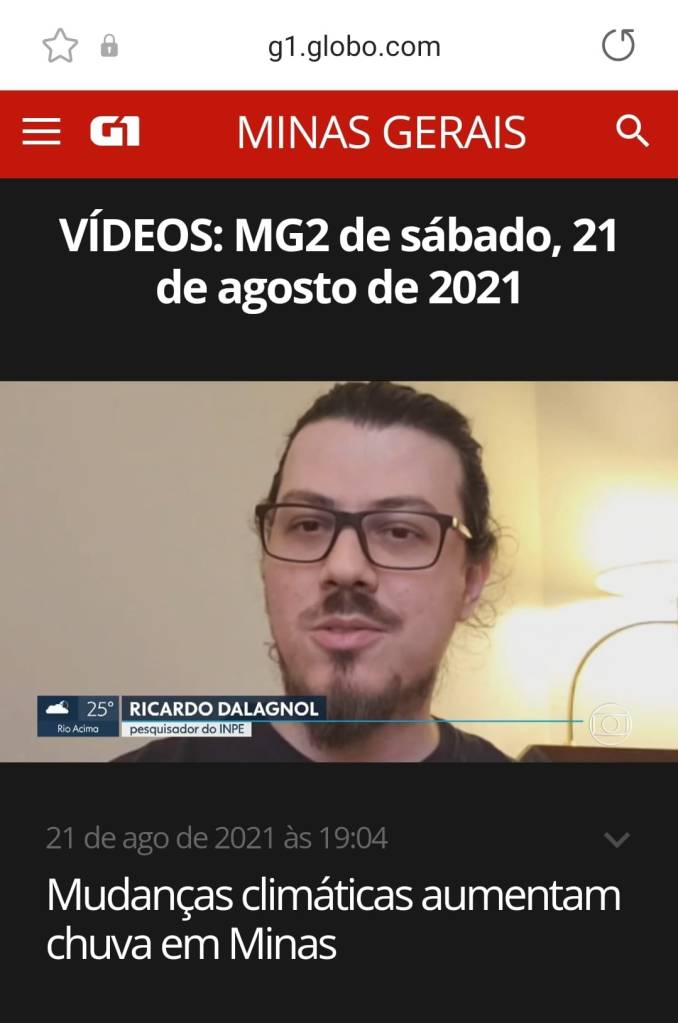
    Aug 2021 · TV Globo Minas Gerais Mudanças climáticas aumentam chuva em Minas – g1.globo.com
  • Watch
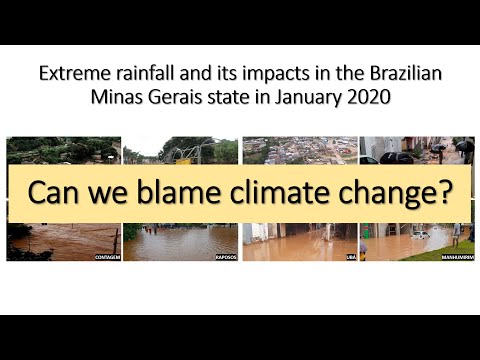
    Aug 2021 · Outreach video Extreme rainfall and climate change in Brazilian Minas Gerais in January 2020 – English version · PT-BR version
  • Read
    Aug 2021 · FAPESP Pesquisadores usam dados de radar para mensurar o impacto do fogo na Amazônia – agencia.fapesp.br
  • Watch
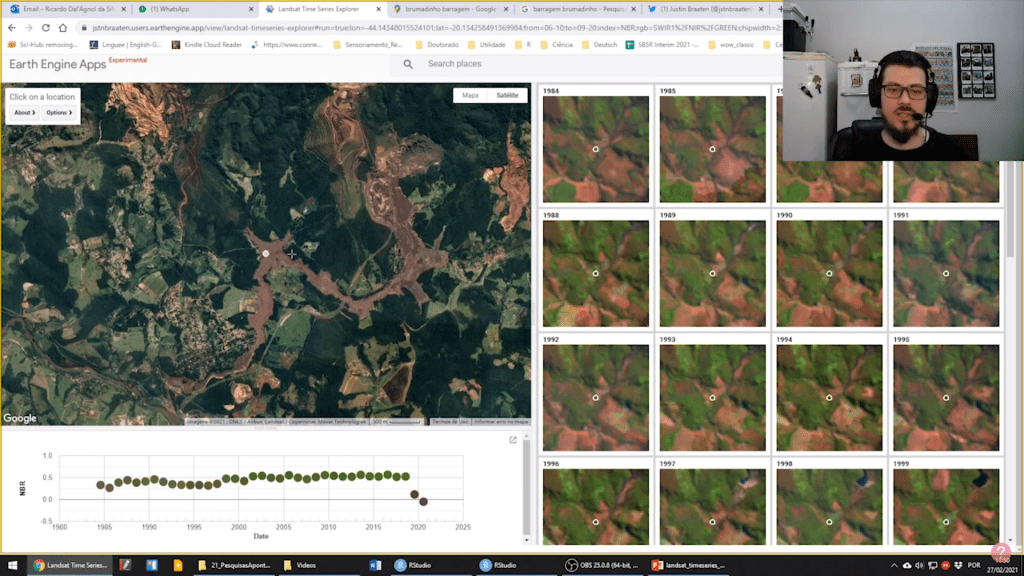
    Mar 2021 · Pesquisas Apontam Tutorial: Landsat Time Series Explorer – Earth Engine Apps – youtu.be
  • Read
    Mar 2021 · CEMADEN Mudanças climáticas e distúrbios humanos ameaçam a capacidade de remoção de carbono pelas florestas na Amazônia – cemaden.gov.br
  • Read
    Mar 2021 · INPE Artigo na Nature Communications mostra que a capacidade de remoção de carbono pelas florestas secundárias na Amazônia é ameaçada por mudanças climáticas e distúrbios humanos – obt.inpe.br
  • Read
    Feb 2021 · FAPESP Laser mapeia clareiras na Amazônia e auxilia estudos sobre mortalidade das árvores – agencia.fapesp.br
  • Read
    Feb 2021 · Pesquisas Apontam Como cientistas sabem quando árvores morrem na Amazônia? – mikhaela.medium.com
  • Read
    Jan 2021 · Mongabay Lasers find forest gaps to aid tree mortality studies in Brazilian Amazon – news.mongabay.com
  • Read
    Jan 2021 · INPE Estimativas em larga escala da dinâmica e avaliação de mortalidade na floresta amazônica – obt.inpe.br
  • Read
    Sep 2020 · INPE Nova pesquisa com a participação do INPE usa Inteligência Artificial no mapeamento de larga escala de palmeiras na Amazônia – obt.inpe.br
  • Read
    Feb 2020 · INPE Florestas modificadas pelo homem estão emitindo mais carbono – obt.inpe.br

Resources

Datasets, code, and guides.

Dataset

Code

Contact

Send a message about collaborations, technical work, research, or data products.

Message

E-mail: ricds [@] hotmail dot com / rdalagnol [@] ctrees dot org

Location

Based in Pasadena, CA (USA) · working globally

Remote sensing scientist in environmental sciences, tropical ecology and forest systems.